
Retraining Your Bladder: A Step-by-Step Guide to Regaining Control

https://www.buzzrx.com/blog/polyuria-excessive-urination-causes
Do you feel like your day revolves around finding the nearest restroom, or that you’re constantly getting “false alarm” urges?
Before diving into bladder training, it helps to understand how your body actually signals that it’s time to go.
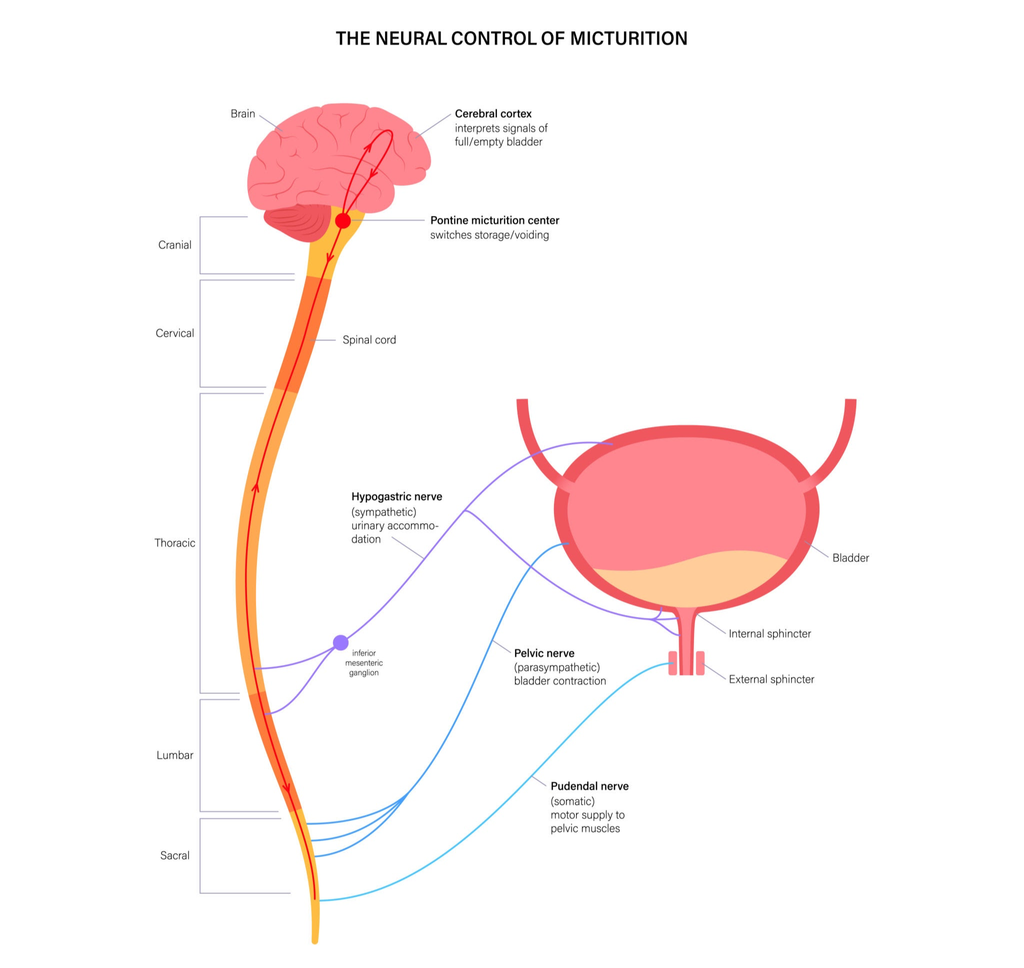
Neural control of the micturition reflex. Source: Pikovit44 / Getty Images
The Science of Urination: How Micturition Works
Urination (medically called micturition) relies on a continuous three-way conversation between your bladder muscle (detrusor), your pelvic floor muscles, and your central nervous system (brain and spinal cord).
- The Filling Phase (Storage Mode): As urine enters the bladder, the bladder wall stretches to accommodate it without increasing internal pressure. During this phase, sympathetic nerves keep the detrusor muscle relaxed and the internal sphincter closed, while your voluntary pelvic floor muscles stay engaged to keep you continent.
- The Stretch Signal: As the bladder reaches about half capacity, stretch receptors in the bladder wall send electrical signals up the spinal cord to the brain.
- The Executive Decision: Your brain’s command center (the pontine micturition center) evaluates the signal. It determines whether it is socially acceptable and convenient to void right now:
- If it IS time: The brain triggers the parasympathetic (rest and digest) nervous system. The detrusor muscle contracts, the internal and external sphincters relax, and urine flows smoothly.
- If it IS NOT time: The brain sends inhibitory signals back down to override the contraction, keep the sphincter closed, and calm the bladder muscle until you reach a toilet.
Why the Signal Gets Dysregulated
When you void too frequently, “just in case,” or respond to every minor blip, the bladder wall never fully stretches. Over time, the stretch receptors become hyper-reactive, signaling “EMERGENCY!” to your brain when the bladder is only partially full.
Bladder training works by recalibrating this neural feedback loop—teaching your brain and bladder that stretch is safe, allowing for full expansion without premature urgency signals.
Step 1: The Bladder Diary (Finding Your Baseline)
Before changing your habits, step one is completing a bladder diary. We use this tool to see how your bladder behaves on a typical day:
- Is there frequent urgency or urge incontinence?
- Is it a fluid issue—such as drinking too much, drinking too little, or drinking large amounts in a short period?
- Are you consuming bladder irritants (like caffeine, carbonation, or artificial sweeteners)?
We want to assess all of these factors first. Once we optimize your fluid habits and control for other triggers, if you are still going to the bathroom too often, then we begin active bladder training.
Step 2: Setting Your Timed Voiding Schedule
Start by determining your current typical voiding frequency from your diary.
- Add 10 to 15 Minutes: If your baseline is going every hour, your new starting goal is 1 hour and 15 minutes.
- Follow the Window: When you wake up in the morning, use the restroom and note the time. You should not go to the restroom again until at least 1 hour and 15 minutes later. Continue following this interval throughout the day.
- Listen to True Urges (No “Just in Case” Voiding): Reaching your time window does not mean you must go immediately if you don’t feel the need. It simply means you do not go before that time. Once your window passes, wait until you feel a real urge to void. We always want to respond to true urge signals and eliminate “just in case” bathroom visits.
- Bedtime Exception: You do not need to stick to the rigid timer right before sleep. You may void right before going to bed so you can sleep comfortably.
- Progress Weekly: Once a schedule feels easy for a few days to a week, add another 15 minutes (moving to 1 hour and 30 minutes, and so forth) until your voiding schedule normalizes to every 2 to 4 hours.
A Quick Tip: Skip the Phone Alarms!
Do not use alarms or timer chimes to signal when your window is up. Alarms create conditioned voiding—your brain learns to associate the sound with going to the bathroom, which can actually trigger a sudden, artificial urge!
What to do instead: Keep a small notepad in the bathroom. Write down the time when you finish using the restroom, do the math for your target window, and make a quick mental note (e.g., “I went at 9:00 AM, so I will not go again until at least 10:15 AM”).
Step 3: Urge Suppression Techniques
To comfortably make it through your time window, use these urge suppression strategies when a sudden wave strikes:
- Quick Pelvic Floor Contractions (“Quick Flicks”): Perform 3 to 5 quick, firm Kegel squeezes. Squeezing the pelvic floor reflexively signals the detrusor muscle to relax via the sacral nerve arch.
- Calm, Easy Breathing: Try Box Breathing (inhale 4s, hold 4s, exhale 4s, hold 4s) to turn down sympathetic nervous system arousal.
- Mental Distraction: Count backward from 100 by 7s, check an engaging app, or focus on a detailed task to override bladder signals in the brain.
- Perineal Pressure: Sit firmly on a hard chair, roll up a towel to sit on, or apply gentle pressure over the area to stimulate sensory nerves that inhibit bladder spasms.
- Heel Raises: Standing up on your toes and lowering back down repeatedly triggers contraction of your calf muscles. The nerves supplying your calves share neural pathways (S1-S2) with the nerves controlling your bladder, helping to reflexively inhibit bladder contractions and quiet the urge!
Need Personalized Help?
If you are struggling with bladder urgency, frequency, or leakage, our pelvic health physical therapy team at Wings Physiotherapy in Rancho Cucamonga and Apple Valley, CA is here to help you get your quality of life back.